 National service hotline:+86(0)755-2898 7706

As a global leader in warehouse-style retail, Costco enforces stringent standards for unitized pallet shipping. These guidelines are designed to maximize supply chain efficiency, ensure product integrity during transit, storage, and shelf placement, and maintain a seamless operational flow. Below are the core requirements for different types of product packaging:
1. Goods Shipped in Fully Enclosed Corrugated Containers
This is the most common format for Costco shelf items, with palletization rules centered on weight limits, stacking capability, and securement:
Weight Restriction: The total unit load weight must not exceed 2,500 lbs / 1,134 kg.
Stacking Requirements:
Packaging and unit load height must support double stacking in transit, whenever Costco warehouses receive full unit load quantities and for Ecommerce.
If double stacking exceeds shippable weight limits, the total pallet load height (including pallet) may be up to 58" / 147 cm.
If a Costco buyer indicates distribution to warehouses will be done in layers, the unit load height is limited only by the loadable height of inbound shipping equipment.
Securement Specifications:
The unit load must be contained and secured to the pallet with stretch film or strapping. Stretch film must be uncolored, with a minimum gauge of 0.79, and wrapped three times or the performance equivalent.
Prohibited items: No metal strapping, metal buckles, non-stretchable tape, or netting.
Safety Caution: Anticipate shipping and handling dynamics to ensure unit loads remain properly contained and secured to the pallet at delivery.
2. Goods Shipped in Display-Ready Packaging
These items are designed for direct consumer display. In addition to all conditions in Section 4.1, extra focus is placed on display protection:
Layer Stabilization: Use non-skid coated paper sheets to stabilize and "tie" layers together. When possible, avoid using corrugated sheets between layers, and do not use layer caps.
Top Protection: Use a layer pad or cap atop unit loads to protect goods in open-top display trays.
Corner Posts: Use paper/fiber corner posts only if necessary. Plastic corner posts are strictly prohibited.
Tipping Prevention: Vertically unstable goods with multiple units per unit load (e.g., tall rugs, mirrors, brooms) must use supports to prevent partially full pallets from tipping over on the sales floor.
Packaging Integrity: Stretch film or strapping must not damage display trays or consumer packaging.
3. Bags Exceeding 10 lbs / 4.5 kg
Bulk bagged goods (e.g., rice, pet food) require more detailed palletization rules to prevent damage and shifting:
Weight & Height Limits:
Unit load weight must not exceed 2,500 lbs / 1,134 kg.
Pallet load height (including pallet) must not exceed 50" / 127 cm.
Layer & Top Protection: A layer sheet or tray is required between the bottom layer and the pallet, and atop the unit load.
Securement Methods (Choose One):
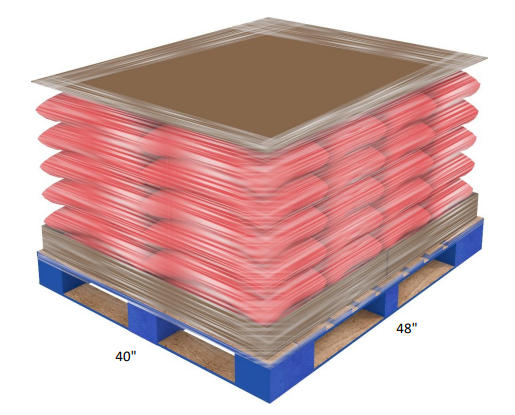
A. Stretch Film: Use 1.2 mil one-side-cling, puncture-resistant, uncolored stretch film. Apply at least three layers of film around the top third and bottom third of the pallet load, and secure the unit load to the pallet.
B. Corrugated Shroud: Fully enclose the unit load with a corrugated shroud, secure it to the pallet with stretch film applied from top to bottom.
C. Pallet-Sized Tray: Use a pallet-sized tray with a minimum height of 12" / 30 cm, secure it to the pallet with stretch film applied from top to bottom.
Safety Caution: Anticipate settling that will occur during shipping and handling; ensure unit loads remain properly contained and secured to the pallet at delivery.
Key Takeaways for Suppliers
Adhering to Costco's unitized pallet requirements is a critical step for suppliers to successfully integrate into the Costco supply chain. While these guidelines may seem detailed, they represent optimized solutions honed through years of operational experience.
Core Principles: Safety, efficiency, and product protection.
Actionable Steps: Carefully review each requirement, confirm special terms with your Costco buying team, and conduct rigorous pre-shipment inspections.
By strictly following these standards, suppliers not only meet Costco's expectations but also elevate their own logistics management capabilities, fostering a mutually beneficial partnership.
Products
Pod Display
Color box
Pdq
Display
Mobile: +86-135 9046 8765/136 6260 0846
E-mail: alan@ctk-hk.com
Tel: +86(0)755-2898 7706
WeChat: 135 9046 8765
Website: www.ctk-hk.com
Add: Building 16, AIPARK, No.2, Baolong 4th Rd., Longgang District, Shenzhen, China


Copyright 2004-2024 CTK PACKING ASIA . All Rights Reserved.